

Steinem, Szold, and the stubborn fight for change
Two Pioneers Who Organized for Change
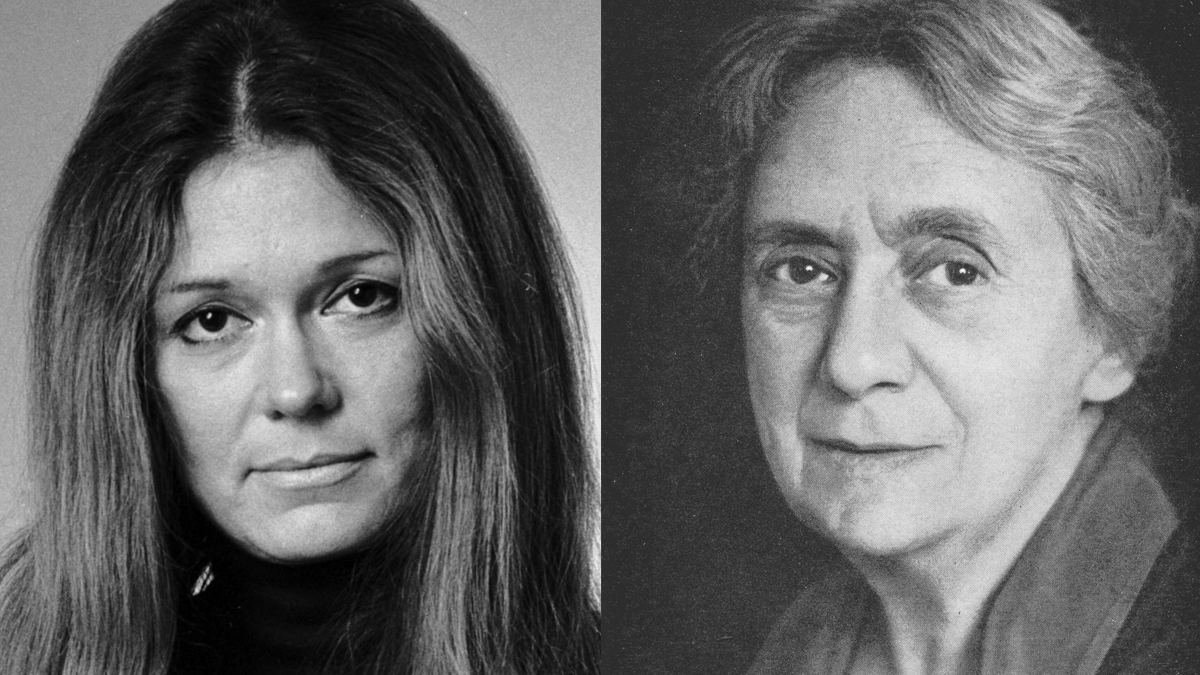
Goodbye, summer. You arrived with your typical warmth, your assurances that every day, even the rainy ones, would be superior to school days, and your guarantee that you would end too soon, but that we’d see your inevitable end from the beginning.
This time, as you depart, you’ve taken with you a handful of people, pioneers who made summers warmer, and whose contributions, notably whose voices, made the world better, regardless of the season.
We count among them Dolly Parton, Peter Cullen, aka Optimus Prime of the Transformers, and Grammy-winning jazz singer Cassandra Wilson, who helped reshape contemporary jazz.
And there was Gloria Steinem.
Steinem, who died at 92, was a journalist, writer, organizer and one of the most recognizable leaders of the modern American women’s movement. She co-founded Ms. magazine and helped establish organizations including the National Women’s Political Caucus. Over more than half a century, she advocated for women’s equality in the workplace, politics and society, as well as reproductive rights and protections against sexual harassment and domestic violence.
When the modern women’s movement emerged, women had far fewer legal and economic rights than they do today. They could face obstacles obtaining credit or bank loans without a man’s signature, had limited recourse against discrimination, and lived in a society in which concepts we now take for granted — including “sexual harassment” — had not even entered the common vocabulary.
Steinem helped give those issues a voice.
Her legacy, and her impact on humanity, is certain, and bears certain resemblances to that of one of the Lower East Side’s modern day pioneers: Henrietta Szold.
Born in Baltimore in 1860, Szold was an educator, editor, organizer and activist who similarly spent her life pushing beyond the boundaries placed around women. She became the first female editor of the Jewish Publication Society and studied at the Jewish Theological Seminary at a time when the idea of female rabbis was virtually unthinkable. Seeing the struggles of Jewish immigrants arriving from Russia and Eastern Europe, she organized nighttime classes teaching English and American citizenship.
Then, after traveling to pre-state Israel and witnessing the effects of disease and poverty there, Szold helped found Hadassah in 1912. The organization initially focused on nursing and public health, sending two nurses to Palestine in 1913 to provide pasteurized milk to mothers and infants and combat trachoma. Szold advocated to build institutions and improve people's lives through direct action.
Later, as the catastrophe facing Europe's Jews became clear in the 1930s, Szold helped organize Youth Aliyah, which brought thousands of Jewish children from Europe to safety in Palestine.
Szold was a Zionist, and never has that ideology been more controversial than today. Yet her actions, like those of Steinem, brought women together. She wrote, raised money, and refused to accept the limitations that society placed upon women, building institutions that lasted beyond her lifetime.
On the Lower East Side, Szold hasn't disappeared from the landscape.
The most obvious example is P.S. 134 Henrietta Szold at 293 East Broadway, an active District 1 public elementary school that bears her full name.
A little farther north is Szold Place, the short street running alongside Dry Dock Playground between East 10th and East 12th Streets. Formerly Dry Dock Street, it was renamed for Henrietta Szold in 1951.
And then there is perhaps the most intriguing Lower East Side trace of all. At 211 Madison Street stands a tenement with the words “THE HENRIETTA” still emblazoned across its cornice. (There’s no evidence proving this is a dedication to Szold, but it’s our strongest hypothesis.)
Gloria Steinem and Henrietta Szold lived in different eras and devoted themselves to different causes. Both saw circumstances they believed should be different, found other people who agreed, and organized to change them.


