
In a bit of a pickle, but also a bialy
Touring Like A Local: Part 1
“Board the last car of the L train, go three stops, and walk up to Bedford and North 7th Street.”
“But why the last car, specifically?”
If you live here, you know. If you don’t, you don’t.
Locals understand the Why behind things in ways visitors do not. (You enter the last car on the Brooklyn-bound L train so that you avoid walking the length of the station to access Bedford Street more quickly.)
Avoid biking the Brooklyn Bridge on a warm weekend day, or slalom through the hordes of tourists with selfie sticks. Have your bagel order ready and know whether they schmear one or both halves. Don’t attempt to drive across town to the Holland Tunnel on the day of the Five Boro Bike Tour.
This last one I seem to forget and re-learn every year.
The point? Locals know things, and even other locals can teach fellow locals something new. This is why I signed up for the Immigrant New York: Lower East Side, Chinatown & Little Italy Food Tour, led by Like A Local Tours.
Sure, I always want a good food scoop, but I also wanted to see how a guide presents the Lower East Side, and how visitors view our amazing neighborhood.
For context, Like A Local Tours is an award-winning, woman-owned and certified M/WBE New York City experience company that provides food and culture tours, private group experiences, corporate outings and more throughout Manhattan and Brooklyn.
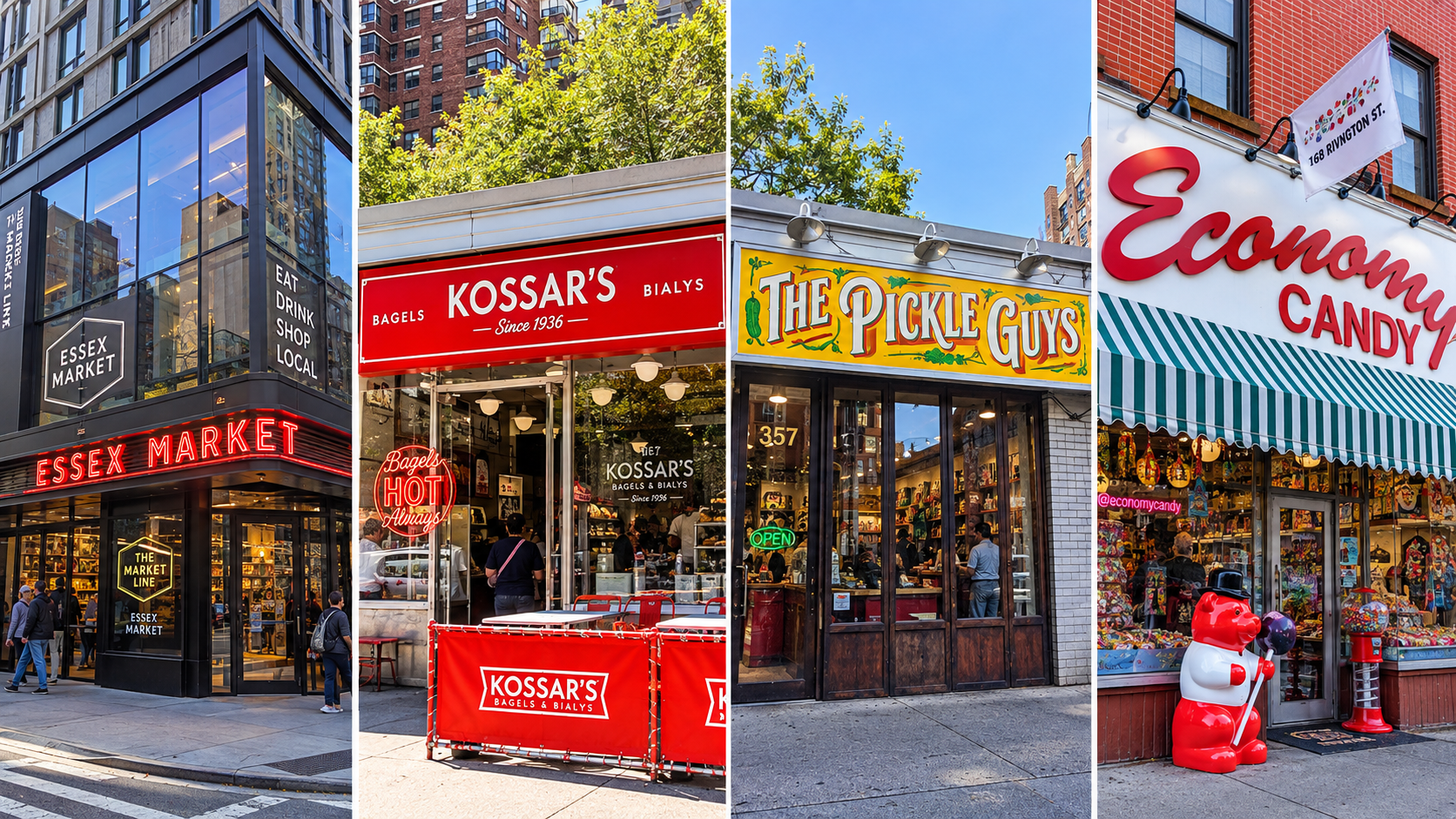
Our experience began just outside Essex Market, which was particularly hopping, courtesy of Daisy Paez and the Hispanic Heritage Celebration, which was in full swing by the start of our tour. I was joined by my mom and younger son, and we met Seth, our guide, and ten or so other tour-mates, with ages ranging from 7–80, representing places like San Francisco, Seattle, and Israel.
Seth quickly introduced himself, checked us in, and we re-entered Essex Market, greeted by Latin music and the type of attendance that could have saved the Market Line. Seth pointed out the historic buildings featured on the tarp covering the downstairs, while I thought to myself, “Shame, if only I could still get a pickle down there and catch a free, fun family concert this afternoon.”
Our first stop was Essex Squeeze for a smoothie, and a dozen or so of us lined up from practically Shopsins to Formaggio Essex. We sampled a custom fruit smoothie, made just for our tour, which was a welcome palate cleanser before the actual food-scarfing began.
After a pit stop at Catalyst Records, which has a truly comfortable chair that proved difficult to dislodge my son from, Seth led us out to Broome Street. He pointed out the former Seward Park High School, which today houses multiple co-located schools, including the High School for Dual Language & Asian Studies; Essex Street Academy; Lower Manhattan Arts Academy (LoMA); New Design High School; and The Urban Assembly Academy of Government and Law.
He likened its appearance to a jail, which speaks to the rooftop exterior. In actuality, this is a pretty incredible event space. Seth did, however, miss an opportunity to link the building’s “jail-like” appearance to the site’s former home, the Ludlow Street Jail, where William “Boss” Tweed met his end. He also could have mentioned some of Seward Park High School’s famous alumni, who include:
- Walter Matthau
- Tony Curtis
- Jerry Stiller
- Estelle Getty
- Zero Mostel
- Keenan Ivory Wayans
- Julius Rosenberg; and
- Luis Guzmán (local celebrity and neighborhood resident)
To Seth’s credit, he did provide a useful historical survey of the neighborhood’s tenements, including a definition and an explanation of how “apartments” came to exist as distinct properties from the overcrowded, unsanitary hovels housing the area’s population.
We then stopped at Kossar’s for bialys, round, baked yeast rolls that look like bagels but have flat centers instead of holes. It was a well-timed treat, because my son, Graham, was getting hungry and was only one stop away from Meltdown Central. The group sampled onion and garlic bialys with cream cheese and butter — not together — along with a bunch of bagel bites. From there, we popped into Pickle Guys for a selection of full-, half-, and three-quarter-sour pickles — the “finest in the city,” as I attested and Seth repeated.
It was an apt moment for Seth to reference Robert Moses, the urban planner and public official who did much to reshape New York City and its suburbs. Like our treats from Pickle Guys, his achievements left a spectrum of aftertastes — from spicy and complex to tart and bitter.
We walked west on Grand Street toward Orchard Street, one of the “coolest streets” in America. I pointed out some local street art by Hektad, which I’d previously thought was Banksy. Were I not a local — and had my children not gone to Victoria Children’s Group, which is housed in the building that features the piece — I wouldn’t have known about the art, although I only learned I was wrong, re: Banksy, while researching this article. (My apologies to my tour-mates who returned home with misinformation.)
At the corner of Delancey and Orchard, we stopped for a bathroom break at the Tenement Museum. A few of us chatted about the street, taking note of Con Bud, a legal dispensary, and Con Body, a fitness studio that pays homage to workouts popularized in prison — both owned and operated by formerly incarcerated people.
Seth knowledgeably shared the path to licensure to legally run New York State dispensaries. When New York legalized adult-use marijuana in 2021, it made social equity a central part of its licensing framework, giving priority to “justice-involved” applicants — people who themselves, or whose close family members, had been affected by marijuana-related convictions in New York before legalization — among the first retail dispensary license holders.
I added, not without irony, that one of the founders is the brother of our local District 1 Council Member, Christopher Marte. Sensing something familiar, a Seattle-based tour-mate chimed in, “It helps to know someone on the inside,” a thought with a multitude of contextual interpretations.
From here, we walked north toward Rivington Street before catching a right. Seth pointed out a true rarity on the Lower East Side — and in New York City generally: a vacant lot at 89 Rivington Street. This is the site of the now-defunct First Roumanian-American Congregation, whose synagogue once stood here. I looked into it later because we learned that the lot has stood vacant, at least in part, because a synagogue would have to be rebuilt on the formerly landmarked site.
That appears to be more urban myth than truth.
What I learned was that the First Roumanian-American Congregation occupied 89-93 Rivington Street beginning in 1902, eventually becoming famous as the “Cantor’s Carnegie Hall” for its extraordinary acoustics and celebrated cantors. The building was added to the National Register of Historic Places in 1998, but after years of deterioration, its roof collapsed in January 2006 and the City subsequently ordered the remaining structure demolished. In the years that followed, the congregation explored transferring the property to a developer who could construct a mixed-use building incorporating a new synagogue, but those plans never materialized — and the site remains vacant today.
The legal trail is harder to snuff out from there.
We continued past the former Wolfnights on the corner of Ludlow, famed for previously housing Paul’s Boutique, the title of the Beastie Boys’ second album. This factoid meant little to the youngsters among us — the children of the Baby Shark “Doot-doot-doot-doot” Era — but, as someone who grew up mostly in the 1980s, I appreciated the insight.
As much as any of us gained from that, we could all relate to Economy Candy, a sweet shop with treats from around the world and across generations, as well as our next stop. The store began as a shoe and hat repair shop before the Depression. Its streetside pushcart sold candy, a business pivot that saved — and outdid — the earlier repair shop by selling candy, chocolate, gift baskets, dried fruit, and nuts after World War II.
It was here, high on sugar, that we headed west toward Little Italy and Chinatown, which is where we’ll pause and pick back up for Part 2 of our two-part Like A Local recollection.
Sources
- Like A Local Tours — Immigrant New York: Lower East Side, Chinatown & Little Italy Food Tour
- William “Boss” Tweed Meets His End on Ludlow Street — The Bowery Boys: New York City History
- People ex rel. Tweed v. Liscomb — Historical Society of the New York Courts
- Seward Park High School — Famous Alumni: Tony Curtis
- Conditional Adult-Use Retail Dispensary (CAURD) FAQ — New York State Office of Cannabis Management
- Conditional Adult-Use Retail Dispensary (CAURD): Completing Your Post-Selection Application — New York State Office of Cannabis Management
- Cannabis Control Board Approves First Conditional Adult-Use Retail Dispensary Licenses — New York State Office of Cannabis Management
- Social Equity Applicant Criteria — Illinois Department of Commerce & Economic Opportunity
- Equity Fee Relief — California Department of Cannabis Control
- First Roumanian Am. Congregation v. GuideOne Mutual Insurance Co., 862 F. Supp. 2d 293 (S.D.N.Y. 2012)
- First Romanian-American Congregation Synagogue — National Register of Historic Places
- First Roumanian American Congregation — About
- New York – Historic Synagogue May Be Demolished — VINnews
- More Renaissance Than ‘Remnants’ — New York Jewish Week/JTA
- First Roumanian-American Congregation — Historical Overview
- Cantors’ Carnegie Hall (First Roumanian-American Congregation) — The Big Apple / Barry Popik