

Walking the streets with Jimothy, Houstoun, and Piscopo
Touring Like A Local: Part 2
If you’re just joining us, welcome. This is the second installment of our two-part review of the Immigrant New York: Lower East Side, Chinatown & Little Italy Food Tour, led by Like A Local Tours, with Seth, our guide, chaperone, and fabulous, fast-to-serve foodster.
For context, Like A Local Tours is an award-winning, woman-owned and certified M/WBE New York City experience company offering food and culture tours, private group experiences, corporate outings and more throughout Manhattan and Brooklyn.
In Part One, we joined the tour as it made its way through the Lower East Side. Now, in Part Two, we pick up where we left off, coming down from an Economy Candy sugar high.
That we’d be coming down where we did made sense as we paused in Sara D. Roosevelt Park, a spot frequented by a host of unfortunate people who have no place to go as they seek — or do not seek — treatment for substance abuse. The park has many other noteworthy and favorable attractions, including spaces for recreation and performance, with soccer, tennis, basketball, kung-fu, and some weird sport I’ve occasionally seen people playing that involves polo on bicycles. It’s a bit Williamsburg 2005, but who am I?
Here, Seth shared two really fascinating pieces of history that have stuck with me.
Just outside the M’Finda Kalunga Community Garden, which was designed to address some of the ills mentioned above, Seth talked about the African Burial Ground upon which we stood. Established in 1795, the plot was a burial place for both free and enslaved Black New Yorkers. Historical records indicate that as many as 5,000 people were buried there, yet records document only 458 reinterments after the cemetery closed — raising the possibility that many remains still lie beneath Chrystie Street and the surrounding area.
He also referenced Houston Street, which — depending on how it’s pronounced — is a dead giveaway for a tourist.
Houston Street was named in 1790 for William Houstoun, a Georgia delegate to the Continental Congress and Constitutional Convention. Originally, the street name was spelled “Houstoun” — and, hence, its pronunciation — “How-Stun,” rather than “Hyoo-Stun,” like Houston, Texas.
We humans are always making things simpler and easier, aren’t we?
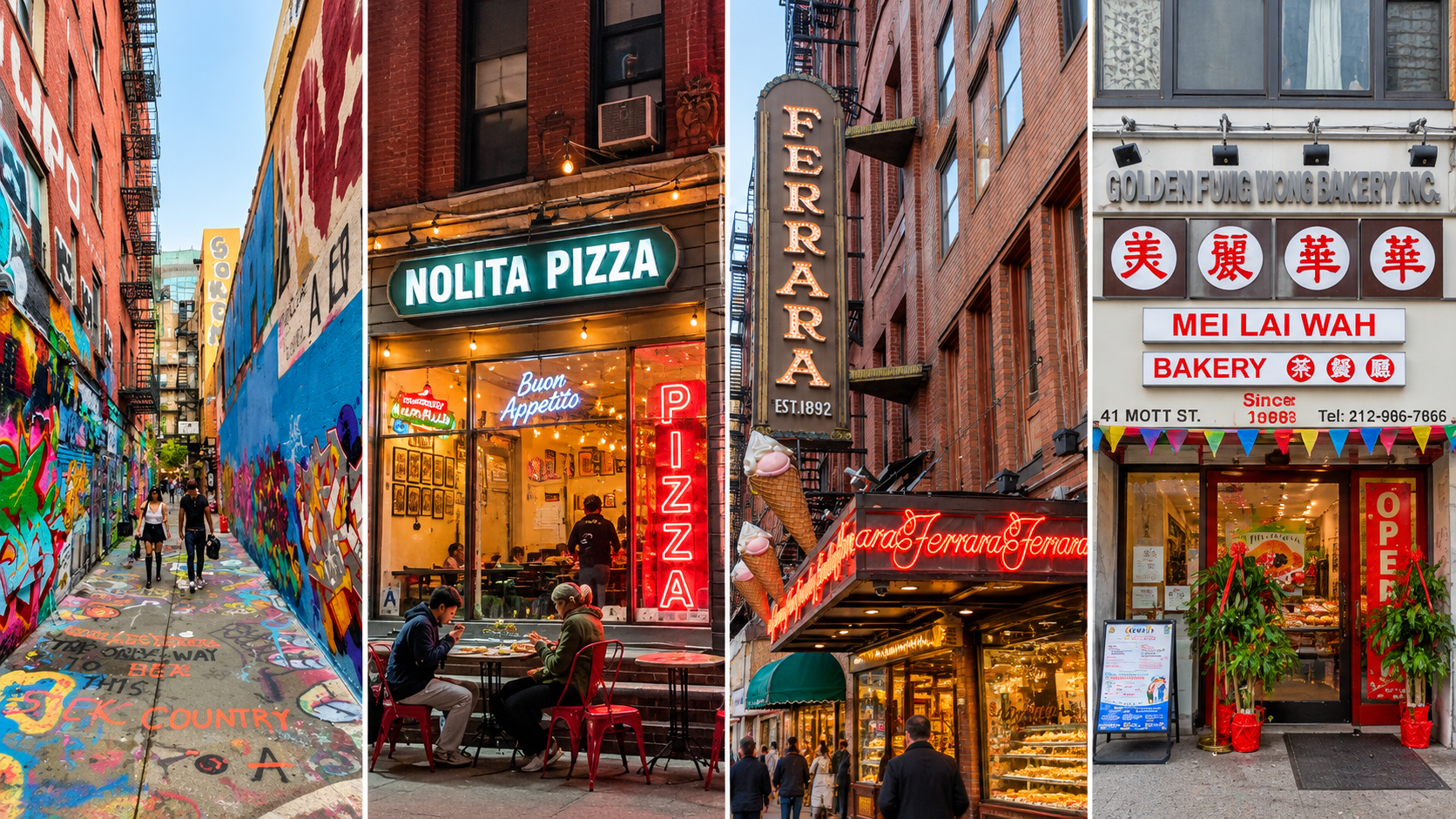
Across the park, we made our way to Freeman Alley, one of the glitziest places to see ever-changing street art, as well as the Untitled Hotel, where we stopped outside to admire a spray-painted version of Jimothy, the Seattle raccoon with a spinal deformity who’s recently become an online legend.
Although we didn’t go inside the Untitled, the space has a hip coffee bar, and guests can literally rent a guitar from a vending machine. My Seattle tour-mates, however, were more interested in sharing how the legend of Jimothy has transformed the social media landscape of their city.
We wound our way across the Bowery, weaving in and around people waiting in line for some kind of Pepsi pop-up. Next up, Nolita Pizza on Kenmare, and we couldn’t get there soon enough, as I had my 7-year-old on my shoulders and he’s no longer under 40 pounds.
Nolita Pizza is unique, and admittedly, I’d never been there. The pizza was tasty, although thus far I’d only had a taste of my smoothie and a pickle, so the slice was as welcome as the seat — and it was delicious.
Side note: I am not a reliable pizza critic. In fact, I’ll eat a slice of pizza — any pizza — at almost any point of hunger, including after a filling three-course meal. I cannot resist pizza.
The slice was toasted and well done, more crisp than soft, and on the lighter side. If we were to think of the dough in terms of bagels, it was closer to a Montreal-style bagel than a traditional New York bagel from the likes of H&H.
Seth astutely led us down Mott Street toward Little Italy.
“Wait, isn’t Little Italy on Mulberry Street?” Yes, indeed.
Our tour coincided with the Feast of San Gennaro 2026, the 100th year of the celebration. Translation: On a beautiful September Saturday afternoon, guiding 14 people down Mulberry Street during the centenary Feast of San Gennaro is enough to achieve sainthood.
Seth, though saintly, was not willing to prostrate himself before Saint Peter, the Pope, or whomever has the final say.
He did the next best thing. He steered us to Ferrara’s for a cannoli. While there, I happened to see Joe Piscopo — deeply tanned and sporting a bright blue suit and fedora — being followed by a camera crew. (Any Johnny Dangerously fans?)
If the authenticity of the fare in Little Italy is lacking, there’s a good reason. Seth highlighted the influx of Italian immigrants, many hailing from Sicily, followed by their flight to the suburbs, leaving the Italian enclave more a reminder of its roots than a bustling hub in the present day.
The cannoli, though, makes up almost entirely for what the sit-down restaurants there lack.
En route to Mei Lai Wah on Mott Street, we learned about Five Points and how Chinatown, whose traditional boundaries had previously remained largely south of Canal Street, expanded northward during the 1960s with the departure of the Italians — another nod to the work of Robert Moses, whom we learned about earlier in the tour.
The steaming pork buns proved a tasty tour cap, and everyone — even my whine-inclined 7-year-old — had a great time. For three hours, we ate and learned and chatted and I saw our neighborhood through a variety of lenses: Tourist, Immigrant, Foodie, and Local.
The best part, though?
As I thanked our guide and bade farewell to our tour-mates, I took my full belly and tired legs a few short blocks back to the place that I call home.
Sources
- Remembering the Second African Burial Ground — FABnyc
- Call for Artist Proposals: Second African Burial Ground — FABnyc
- Students Connect Urban Health With Green Space—and Help Create an Exhibition that Honors a Nearby Burial Ground — Borough of Manhattan Community College
- Manhattan Week: Houston Street Pronunciation Traces Back to Revolutionary War Patriot — NY1
- Why is New York’s Houston Street pronounced “How-stun?” — 6sqft
- Houston Street: River to River — Forgotten New York
- Chinatown and Little Italy Historic District — National Park Service
You may also enjoy
In a bit of a pickle, but also a bialy
A Lower East Side local joins a neighborhood food tour, revisiting Essex Market, tenement history, Kossar's, Orchard Street and Rivington Street.