

Bare-knuckle boxing, rigged elections, opium dens, brothels, and more!
Five Points by Tyler Anbinder
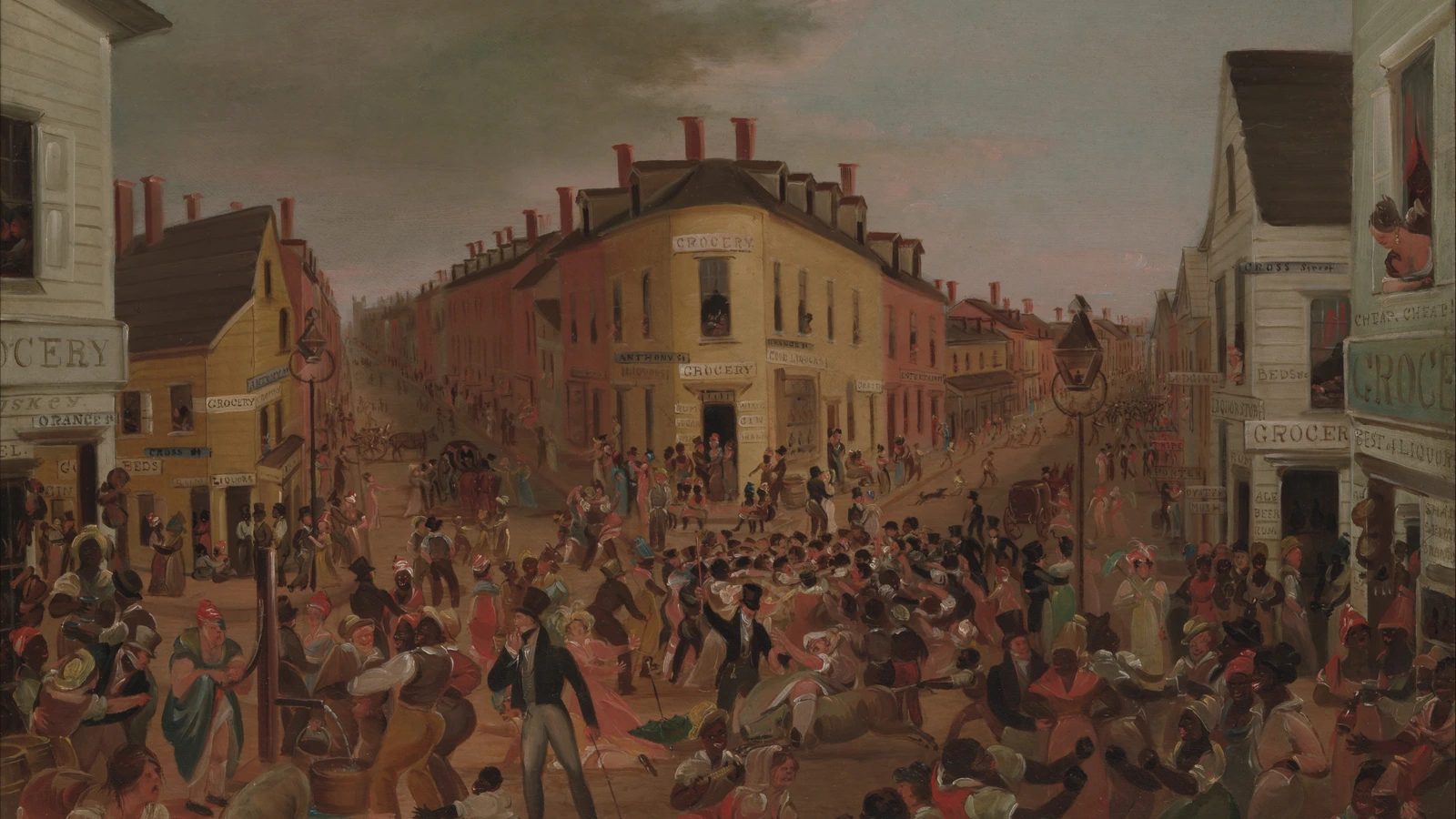
Tyler Anbinder’s Five Points is a revealing portrait that details how one distinct — even notorious — neighborhood evolved as the New York of yore became the one we now know.
One of my ongoing projects through More For LES is to learn and educate myself about the role of the Lower East Side in New York’s social and cultural story, viewed through the lens of real estate. I accomplish this in numerous ways, and books are one — well, audiobooks, but I am a voracious listener, so I get half a star.
Neighborhoods do not evolve in isolation. The Lower East Side was influenced by what surrounded it, what fed into it, and what spilled out from it. For this alone, Five Points is essential reading.
The area known as Five Points sat just south of today’s Chinatown and Collect Pond Park area, near the courthouses, jails, and civic buildings below Canal Street. Its influence, though, extended outward into what became Chinatown, Little Italy, and east toward Corlears Hook. Anbinder traces the neighborhood from its early days, when the area was home to breweries, slaughterhouses, cattle yards, and industry, through its transformation into one of the most infamous immigrant slums in American history.
In antebellum New York, the city was expanding rapidly, unevenly, and with little infrastructure to support the populations arriving at its shores. The Irish fled famine. Germans and freed Black Americans sought new beginnings. Italians left behind poverty in search of prosperity. Eastern European Jews escaped persecution. Chinese immigrants followed.
Some arrived as complete families, but many did not. Parents came first and sent for children later. Children arrived ahead of their parents. Families fragmented temporarily in pursuit of work, stability, and survival. Many found circumstances worse than where they left, with even less support locally.
Five Points earned a national reputation for violence, vice, gambling, prostitution, alcoholism, gangs, corruption, and political manipulation. Much of that reputation was deserved, and Anbinder takes you through the trials of rag-pickers and beggar-children, as well as some of the enterprising upstarts who influenced the community and made it up and out — if not just through.
The tenements were overcrowded and poorly ventilated. Sewage systems were inadequate or nonexistent. Clean water was a luxury, and disease spread rapidly. Regulations governing housing quality, sanitation, light, and air barely existed. Many people worked crushing manual labor jobs, if they could find work at all. Others fell into crime, hustling, or political patronage systems connected to Tammany Hall and the ward politics of the era.
This here is our real estate angle.
When we look at the precursors to what we now think of as tenements, the homes — often wooden, at first — lacked light, heat, and any semblance of proper air circulation. Washing facilities inside the homes did not exist, so many residents relied on shared outhouses out back that were not connected to sewage lines. Landlords used every inch of their property to build rudimentary structures and pack people in. And when work dried up — which it often did — families took on boarders and rented out space within their own rooms just to help put meager food — or alcohol — on the table.
And yet, alongside what seemed like misery, there was culture, there was entertainment, and there was relief and release. Dance halls, cheap theaters, saloons, street performers, and prizefighting arenas filled the district. Tap dance, for instance, found its beginnings in Five Points, blending Irish step dancing traditions with African rhythmic movement into something distinctly American.
One of the most powerful outcomes of the Five Points story is the way documentation itself became a force for reform. Anbinder touches upon the work of Jacob Riis, whose photographs and writings in How the Other Half Lives exposed the realities of tenement life to wealthier New Yorkers who had never seen such conditions firsthand. (Of course, people who’d gone “slumming” — rich folks visiting the slums for entertainment’s sake — is another matter.)
Riis himself arrived as an immigrant, struggling before eventually turning his lens toward the city’s poorest residents — literally. The visual record he created through photography helped catalyze reforms around housing, sanitation, and tenant protections that continue to shape New York housing policy today.
What struck me most while listening to the book was the fragility of life for these newcomers — many mere children. New York offered possibilities, but no guarantees. Language barriers, limited labor opportunities, discrimination, illness, corruption, and overcrowding formed the backdrop of daily life. And yet people stayed.
This book — even in audio form — is dense with anecdotes, census records, political histories, newspaper accounts, and individual stories. I’ve probably forgotten most of it, except what you see here.
Today, many physical traces of Five Points are gone. Urban renewal, civic construction, demolition, and redevelopment erased much of the original neighborhood. But remnants persist — in the street patterns, in the surrounding architecture, in the staying power of Chinatown and Little Italy.
I highly recommend the book, particularly for anyone interested in the historical roots of the Lower East Side and lower Manhattan more broadly. And afterward, I’d recommend taking a long walk downtown — through Chinatown, around Collect Pond Park, past the courthouses, through Little Italy, and eastward toward the waterfront — while imagining what it might have felt like to arrive there generations ago, stepping into a city that promised opportunity, even when it offered very little else.
Maybe also do it with a dumpling or a cannoli.