
Taking a dip in the ritualarium on East Broadway
A Century of Community, Collective Effort, & Female Champions
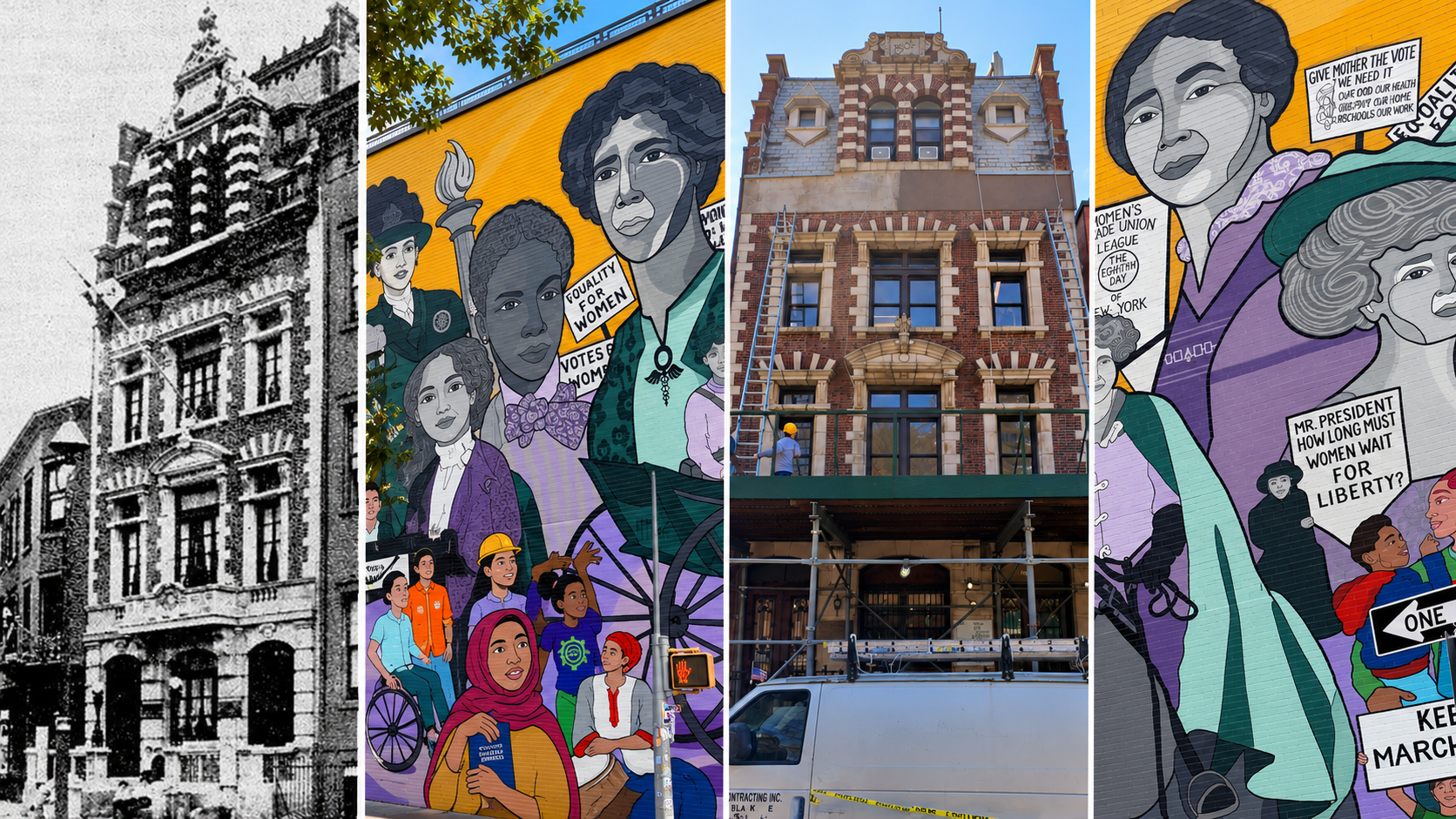
In my household, we’ve been talking a lot about the new mural at P.S. 134 Henrietta Szold on East Broadway. The colorful painting is easily 30 feet high and features women campaigning for equal rights, carrying signs that read, “Mr. President, how long must women wait for liberty?” and “Votes for Women.”
We tracked its progress daily, yet somehow the finished work still seemed to appear overnight. It’s become a spectacular visual magnet, drawing our attention every time we walk or drive past. Right now, it might be the most remarkable thing on the block between Grand and Montgomery streets.
But only if those vibrant colors draw your eye away from the spectacle that is 311 East Broadway.
Situated at the intersection of East Broadway and Grand Street, the five-story building is an architectural curiosity, particularly in a neighborhood where so much of the original building stock has been replaced by 1950s-era residential towers in the surrounding cooperative developments.
Its red brick facade, limestone and granite detailing, arched windows, and distinctive stepped gables give it an unmistakable presence. Combining Flemish Revival architecture with Beaux-Arts ornamentation, the building is conspicuously elaborate compared with its more restrained brick neighbors.
And that's before you learn its history.
The story begins in the late 19th century with the Young Men's Benevolent Association (YMBA), a mutual aid society established by Jewish immigrants on the Lower East Side. At the time, the neighborhood was densely populated, its residents often living in overcrowded tenements and working long hours in factories and workshops, with limited access to decent sanitary conditions or opportunities for recreation.
The YMBA sought to provide something better.
For nearly 16 years, its members worked toward establishing a permanent home for the organization, gathering contributions from working-class supporters until they had raised approximately $50,000 — an extraordinary sum considering the modest means of those contributing.
The association commissioned Sass & Smallheiser, an architectural firm responsible for numerous Lower East Side tenement buildings, to design its new headquarters. By the spring of 1905, an elaborate structure with a prominent entrance porch and rooftop ornamentation — features that have since disappeared — stood at the intersection of Grand Street and East Broadway.
Inside were a circulating library, reading rooms, a gymnasium, bowling alleys, billiard facilities, meeting rooms, and an auditorium for lectures and public gatherings. These amenities offered opportunities for education and social interaction, things that many neighborhood residents might otherwise have been unable to afford — assuming, of course, they could find the time to enjoy them.
In 1918, it entered another chapter when it became the home of Arnold Toynbee House, a social settlement established two years earlier on Division Street. Named for the British economic historian and social reformer, the organization was led by Rose Gruening, a social worker whose contributions to the Lower East Side would eventually earn her the nickname “The Angel of Grand Street.”
Like fellow reformer Lillian Wald, who had established Henry Street Settlement a few blocks away in 1893, Gruening believed that improving the lives of immigrant families required more than charitable assistance.
At 311 East Broadway, the organization — renamed Grand Street Settlement in 1925 — provided showers, medical and dental services, meals, English-language instruction, and a kindergarten for children of working parents.
Both women understood that access to education, healthcare, recreation, and cultural opportunities could make a meaningful difference in the lives of their neighbors. And while Wald became nationally recognized for her contributions to public health and social reform, Gruening made her mark on Grand Street, helping establish an institution that continues serving New Yorkers more than a century later.
By the 1930s, Grand Street Settlement was preparing to leave the building, eventually relocating elsewhere on the Lower East Side.
Today, what stands out — at least at eye level — is a bronze plaque bearing the word Ritualarium. What sounds like a secret chamber at Hogwarts School of Witchcraft and Wizardry is actually a mikvah, a ritual bath used in Jewish religious practice.
The practice of ritual immersion dates back thousands of years. By 1941, Agudath Taharath Mishpachah, or the Association of Family Purity, had reportedly acquired the building and spent $25,000 converting part of it into a mikvah.
In a 2007 article for The Villager, linked below, journalist Bonnie Rosenstock describes four immersion pools, separate facilities for men and women, and an operation supported by donations and income from commercial tenants occupying other portions of the building. At the time, approximately 250 men and women used the facilities each month.
The current status of the baths is unknown. (I have never been in the building.)
Which brings us back to that new mural at P.S. 134. The painting celebrates women who fought for rights that were not freely granted. Next door, 311 East Broadway stands as a reminder of another kind of collective effort: working-class immigrants pooling their resources to create opportunities for themselves and their neighbors, followed by reformers such as Rose Gruening, who devoted their lives to expanding those opportunities.
Besides sharing a wall, the connection between the two was not obvious beforehand. Now, it seems — whether by design or coincidence — the terminus of East Broadway, which was formerly the home of Grand Street Settlement and remains home to P.S. 134, stands in solidarity with the message of the mural next door.