
How the purchase of Alaska led to the first public playground in the U.S.A.
Neighborhood icons: Seward Park
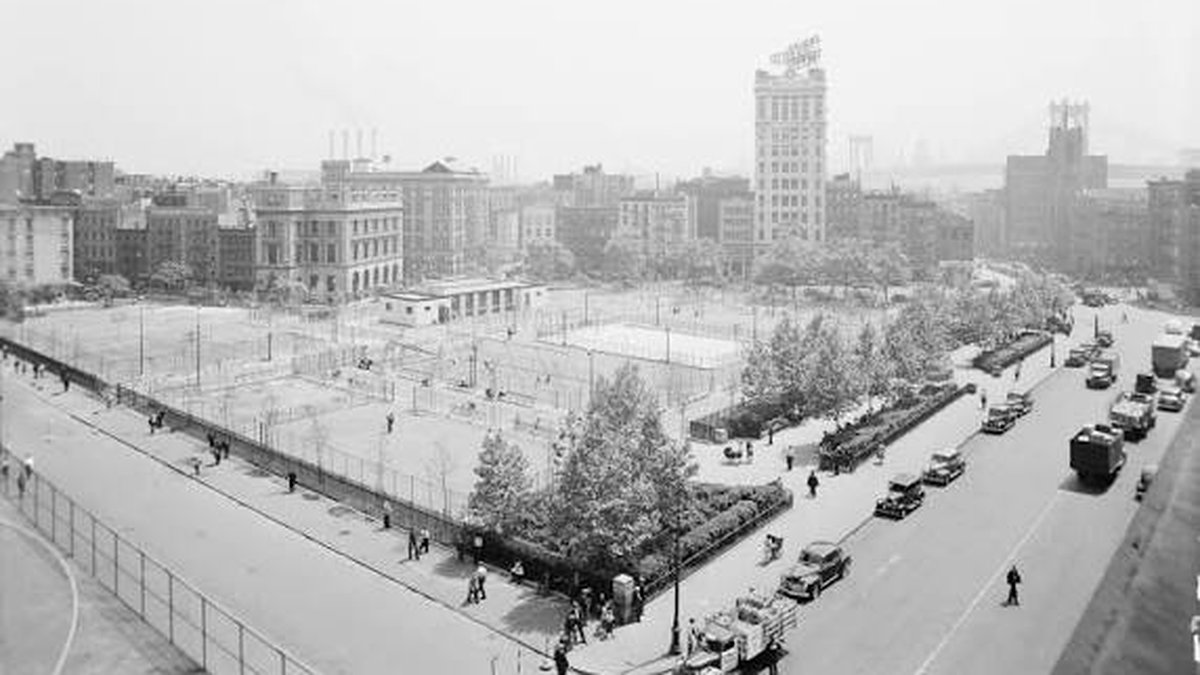
Whether you’re on your way out of the library , claiming an open bench to sip your morning drip from Cafe Grumpy , watching a full-contact ping-pong game at its apex , or dodging two kids chasing one another , take a moment to acknowledge Seward Park’s place in history .
Set at the crossroads of Essex Street, East Broadway, and Canal Street , Seward anchors an important corner of the Lower East Side — and its history. Its origins trace back to a bygone era when children had virtually no safe place to play . (You might actually question whether that era is, in fact, bygone .) It was created in 1903 and it transformed local life, to the same extent that it is a fixture of our daily routines today .
The park itself marked the birth of the first permanent, municipally-built playground in the United States . Opened in 1903, the original design featured a cinder-surfaced playground on the northern end; a neo-classical pavilion with rocking chairs for mothers and children ; gymnastic equipment ; curved pedestrian paths ; a running track encircling a central open field ; and a children’s farm garden in the southeast corner . Early newspaper accounts reported that as many as two thousand children rushed through its gates on day one . The park was immediately considered a national model for what an urban playground could be .
Seward Park is named for William Henry Seward, the former New York governor, senator, and U.S. Secretary of State remembered for negotiating the 1867 purchase of Alaska . Seward was a fierce abolitionist and an advocate for immigrants , earning strong support from Irish and other working-class communities throughout his political career. Naming the park after him established a link between the Lower East Side’s immigrant population to a national figure who championed their rights .
Before the park even existed, reformers were already laying the groundwork for open space in the neighborhood . The Aguilar Free Library Society purchased a lot on East Broadway in 1886 and erected a modest library building by 1890 . Meanwhile, as tenement blocks swelled with newcomers from Eastern Europe, Italy, Ireland, and beyond , settlement-house leaders Lillian Wald and Charles B. Stover grew increasingly concerned for children growing up in dangerously crowded streets . In 1898 they founded the Outdoor Recreation League , an early effort to bring organized play, greenery, and safe recreation to areas that had none. Between 1898 and 1902, the League created nine playgrounds across the city . Their success and growing demand eventually led the City of New York to assume control of these playgrounds — and to establish a new, ambitious recreation space on the Lower East Side.
Both Wald and Stover were active locally ; Wald is the founder of the nearby Henry Street Settlement .
Seward Park continued to grow in subsequent years . In 1904, a limestone and terra-cotta pavilion was added , offering a gym, meeting rooms, and what became the first public bathhouse in any New York City park . The nearby Aguilar library building was replaced in 1909 by a new Seward Park branch, funded by titan of industry Andrew Carnegie ; that library still serves 10002 today .
In 1936, Schiff Fountain, originally installed in Rutgers Park in the 1890s, was relocated to Seward Park . That same year, the original pavilion was demolished . A new recreation building, the Park House, opened in 1941 with restrooms and a community room . The park’s recreational offerings expanded to include basketball , horseshoes , shuffleboard , roller-skating , ice-skating , and paddle tennis . (There is little clamoring for horseshoes and shuffleboard today .)
Nearly three quarters of a century later, New York City Parks redesigned Seward Park again . This overhaul included period-style benches and lampposts , the restoration of historic fencing , and a spray-shower plaza with a circular mosaic map of the neighborhood . Given William Seward’s Alaskan fame, the 2001 renovation inspired playful nods to the north , e.g., a seal-shaped spray shower , a Mount McKinley climbing structure , and a bronze statue of Togo, the sled dog who helped save the town of Nome during the 1925 diphtheria serum run .
Note for those mixed up: Togo is to Nome as Toto is to Africa .
Most recently, the 2019 Parks Without Borders initiative reimagined Seward’s edges and gathering spaces . This project saw fence heights lowered , entrances widened , and the southeast courtyard become more accessible through landscaping , a storytelling alcove , and a wildflower garden . The intention of these changes was to soften the park’s perimeter and make it more welcoming for families , seniors , and passersby .
More than a century later , Seward Park remains exactly what Lillian Wald and Charles Stover hoped it would be: a joyful and (largely) safe refuge in a neighborhood built by and for people representing different backgrounds and walks of life…many just passing through for a little afternoon ping-pong .
Sources: NYC Parks, Seward Park Conservancy, ePortfolios, LillianWald.com, Library of Congress, The Bowery Boys, American Kennel Club, People