

A cathedral of learning converts to a cathedral of arts and culture
Brick and Stone at the Clemente
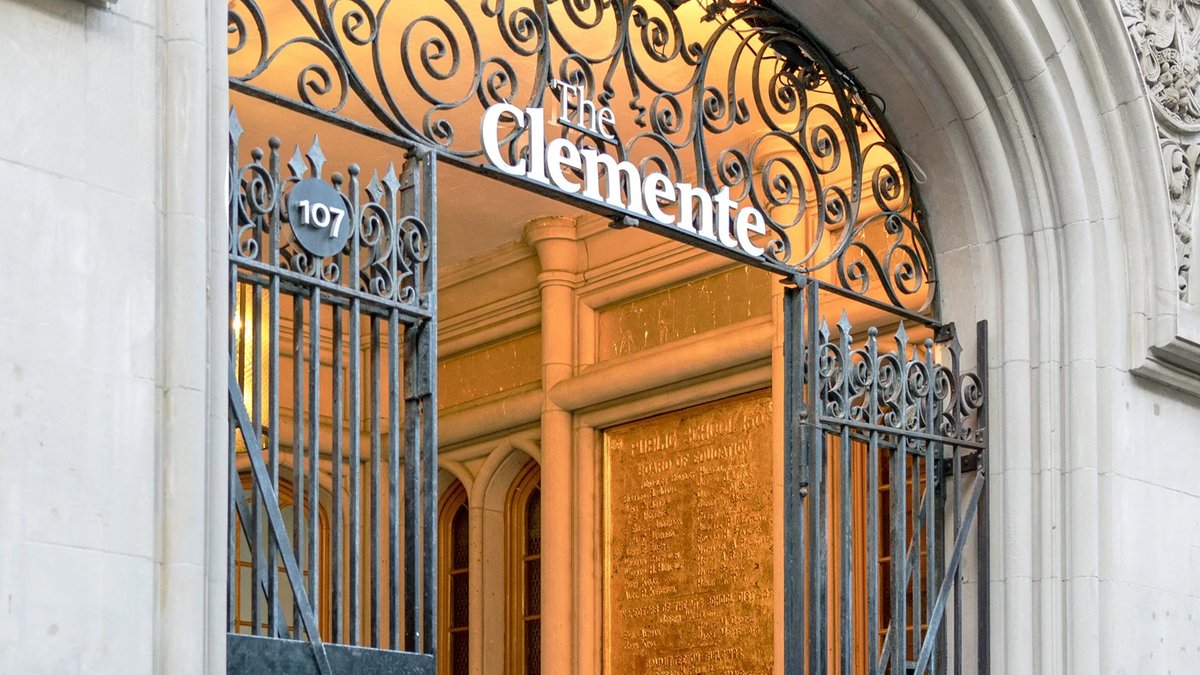
107 Suffolk Street is home to the Clemente Soto Vélez Cultural and Educational Center, a Puerto Rican and Latinx cultural space rooted in the Lower East Side.
It’s been that way since 1993, when it was founded by members of the Latino arts community and named after Puerto Rican poet and activist Clemente Soto Vélez. That same year, the organization assumed management of the building and began operating it as a cultural and educational facility.
But the magnificent building at the corner of Rivington and Suffolk Street dates back much earlier. Constructed in 1897 as Public School 160, the collegiate neo-Gothic style structure was designed by…wanna guess…?
You win 8 points if you guessed Charles B. J. Snyder. (Points are doled out arbitrarily, but Snyder is the safest bet if the question falls under the category of “School” and “New York City” and “100+ Years Ago”.)
P.S. 160 was built during a period of large-scale public school expansion in New York City and was part of Snyder’s consummate body of work as Superintendent of School Buildings for the New York City Board of Education. (You may recall his work erecting “Cathedrals of Learning.”)
The multi-story masonry school building incorporated structural steel framing, large window openings to increase natural light, and a mechanical ventilation system consisting of basement fans, vertical air shafts, and a roof structure that functioned as a ventilation tower.
The space operated as a public school for several decades into the twentieth century, remaining true to its original purpose until the mid-1970s. Throughout its period of operation, multiple fires were recorded within the building, including incidents in 1915, 1923, and several in 1957, one of which required the evacuation of approximately 800 students within minutes.
Accounts from former students reference an earlier fire affecting the fifth floor prior to the mid-1950s, after which that level was no longer actively used. By the 1960s, reports indicated that portions of the building, including the fifth floor, had been condemned and not repaired. The building’s closure in 1975–1976 followed a period of physical deterioration, deferred maintenance, and operational challenges, although the rumor mill suggested that it was closed on account of fire. (That is untrue.)
Following its closure, students were relocated to the newly opened P.S. 142, Amalia Castro School, located at 100 Attorney Street on Rivington Street.
Unlike Seward Park High School, whose alumni are a veritable celebrity Who’s Who, e.g., Tony Curtis, Walter Matthau, Jerry Stiller, Estelle Getty, Keenan Ivory Wayans, and local favorite Luis Guzmán, P.S. 160’s graduates were fewer but still impressive. Two known students include New York City Mayor Abe Beame and acting teacher and theater director Lee Strasberg.
Following its closure, the building remained vacant and in disrepair for several years. In 1980, a community-based organization, Soledad Humana, began occupying the building. The organization used the space to provide educational programming for Spanish-speaking immigrants and subleased portions of the building to artists, theater groups, and cultural organizations. Interestingly, in its early years, the building held evening classes for immigrants who wanted to learn English — many of whom hailed from Eastern Europe.
Since 1993, the building has remained city-owned while being operated as a nonprofit cultural center. The Clemente has developed programming that includes performing arts, exhibitions, and community-based initiatives.
This, in part, was what drew my attention to it now; but, more on that below!
Within the building are multiple performance and exhibition spaces, including theaters and gallery areas, as well as studios and offices used by artists and arts organizations. The original architectural and functional features give some oomph to its current programming slate. These include large window openings, high ceilings, and structural systems designed for light, ventilation, and flexible interior use. Historical accounts describe movable partition walls that allowed classrooms to be combined into larger assembly spaces, as well as performance platforms integrated into upper floors.
Not everything, though, is from yesteryear. The building has undergone restoration and capital improvements, including a full exterior restoration in 2012 that preserved and revealed original façade details.
Right now — before graffiti vandals paint over the display — you can catch a L.E.S.P.I. (Lower East Side Preservation Initiative) installation highlighting a dozen notable Lower East Side buildings, including P.S. 160. The posters are displayed along the exterior gate surrounding the building.
It’s worth seeing while it’s up.