

Getting up in yo (security) grille
The Passage of Local Law 123
What helps commerce thrive in a neighborhood?
There are the familiar answers: businesses that draw people in, events that give people a reason to visit, and cleaner, safer, easier ways to get around. All of these help make neighborhoods more appealing to explore.
Having Una Pizza Napoletana also helps!
Here’s one additional factor that may be less obvious: the security grille outside a storefront.
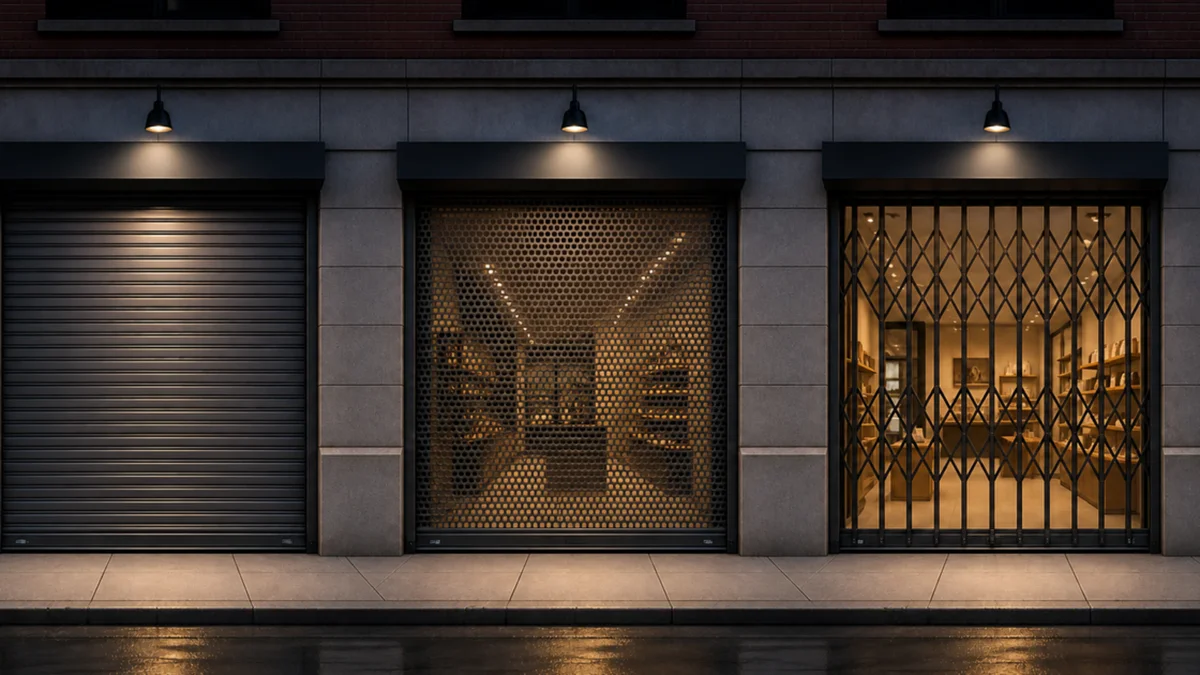
A security grille is the metal barrier a business lowers or pulls across its windows or entrance after closing. As the examples above show, some are solid, some are perforated, and some are open-style gates that allow people to see directly into the store. In a city where owners must protect merchandise, equipment, and inventory overnight, they can be an important practical safeguard.
Lower East Siders may recall a recent rash of vandalism at small businesses, including Go Sushi on Grand Street. Even when an incident results more in nuisance and inconvenience than major loss, it creates concern for a business owner and can leave a block feeling less secure.
For years, New York City had a different concern in mind: how closed storefronts look and feel for people walking the street. Local Law 75 of 2009 required many sidewalk-facing security grilles at business and mercantile properties to permit at least 70% visibility when closed. The law applied to newly installed or replaced grilles after July 1, 2011, and set July 1, 2026 as the deadline for existing grilles to meet the same standard.
In other words, an owner with an older solid or low-visibility grille could have been required to pay to replace or modify it — even if it was working as intended — to comply with the city’s visibility rule.
That changed this summer.
The City Council’s Intro 910-A, now Local Law 123 of 2026, repealed the visibility requirement and the July 1 deadline. Businesses are no longer required to replace an existing grille simply because it does not allow 70% visibility from the sidewalk.
The change does not require a business to have a grille, and it does not eliminate the usual building-code, egress, or permitting requirements for a business that chooses to install or replace one. It does, however, restore a measure of choice. A business owner may choose a solid shutter, a perforated gate, an open-style grille — or no grille at all — based on the needs of that particular storefront.
For many small businesses, that flexibility is welcome news. It means no mandatory new expense tied solely to the former visibility standard, and it recognizes that storefront security is not one-size-fits-all.
For people who live in the neighborhood or come to spend time here, the change may not be immediately noticeable. But it is part of a wider conversation about what makes a commercial zone feel welcoming: not only the browsing and shopping experience, but also the security and confidence that help businesses remain open and invest in the block.
As people walk Orchard, Ludlow, Rivington, and Stanton Streets, grille status matters. A lively Lower East Side needs storefronts that invite people in during the day — and business owners who feel able to choose how to protect what they have built at night.