

Five questions that expose the myth of this sandwich artist and “trophy asset”
334 Grand Street: Investment Profile — Part 2
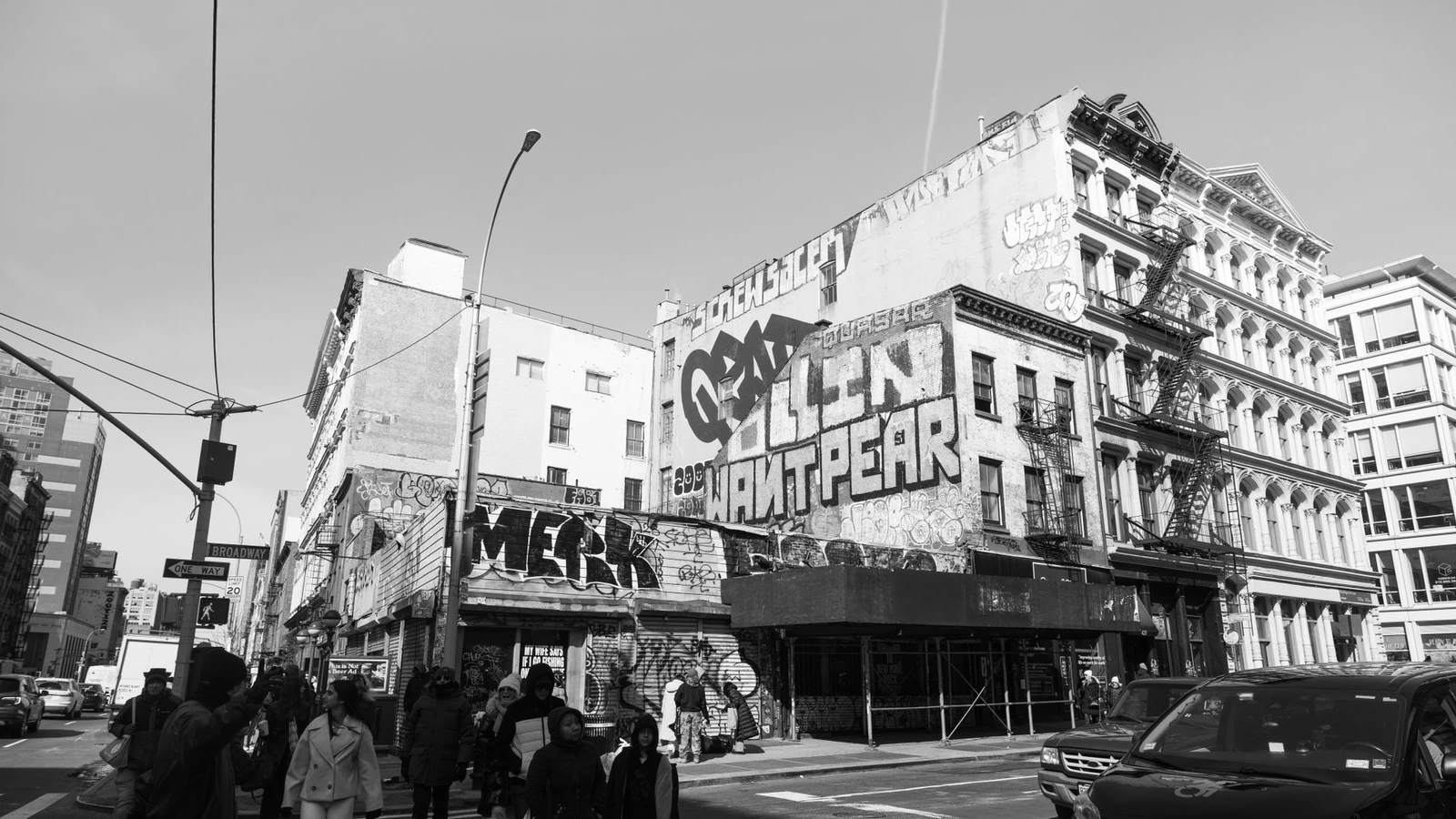
Today, we’re resuming our investment review of 334 Grand Street, an 8,500 sq ft building with 5 bedrooms, 5+ bathrooms, a triplex with several terraces, a Subway on the ground floor, asking $11.5M.
The question: Should we, as a qualified investor, buy it?
The listing agent(s) say(s) this about 334 Grand:
It’s a 7-story mixed-use corner building offering retail plus full-floor lofts and a penthouse triplex. It’s described as being “at the Nexus of Art, Fashion, and Innovation,” and as a “strikingly handsome,” newly constructed “corner masterpiece.”
This property offers a “rare opportunity” to shape your own program. Recently rebuilt, it’s presented as a “trophy asset” offering flexibility, while already being home to “discreet leaders in fashion and titans of industry.”
Before we do any real thinking or number crunching, let’s pick apart some of the broker-speak and fill in more details about the area. Better said, what’s Objective and what’s Subjective?
Objective: Recently rebuilt, 7 stories, mixed use, corner location, in a prime LES location, i.e., one block east of one of the “coolest” streets in the world (Orchard).
Subjective: “Rare opportunity” to “shape your own program” with a “trophy asset” that is both “masterpiece” and “handsome.” (These are all in the eye of the beholder, of course.)
Does the space itself intrigue you?
Now, for something more substantial. Here are 5 key questions:
What is the actual square footage?
The listing cites 8,500 sq ft, but without verified rentable-area measurements, we must assume this figure includes cellar space, circulation, and gross construction figures — meaning the true rentable square footage could be far less, i.e., under 7,500 sq ft.
Thus, if the price/sq ft moves from ~$1,350 ($11.5M/8,500) to $1,530 ($11.5M/7,500), we move into a higher price point . From here, the investment strategy has to justify the step up, meaning each of the units has to generate $180/sq ft more.
What is the rent roll?
Here, we have to say, “We just don’t know,” which is also to say, if we were actively pursuing this property, we would ask the listing agent(s) for information.
What we do know is there’s currently a Subway sandwich shop in the ground floor retail, but it’s unknown whether — and how much of — the remainder of the building is occupied.
A building tagged at $11.5M and marketed as an income-producing asset but providing no in-place income would be treated as speculative, not stabilized . Any underwriting must assume that the retail may be vacant, the loft floors may be vacant, the penthouse may be vacant… basically, you’re buying a blank shell with no guaranteed cash flow.
If that were, in fact, the case, it would be a very risky proposition.
What are our realistic expectations for this asset?
To manage expectations, let’s look at this comparative 1BR unit at 49 Ludlow Street, asking $5,850/month. We’ll ask $6K for our 1BRs.
Using the ol’ cocktail napkin math :
3 x 1BR units @ $6,000/month = $18,000
Triplex @ $15,000/month = $15,000 → Residential = $33,000/month
Now, let’s give the benefit of the doubt and say Subway has 1,600 sq ft and is paying $110/sq ft/year → $14,667/month → Commercial = $176,000/year. (I am basing this on a nearby comparison.)
Annual rent roll = $396,000 (Residential) + $176,000 (Commercial) = $572,000
Let’s round up and say the building can command a bit more: $600,000/year. That brings us to our next question.
What is the NOI?
The NOI — net operating income — is the rent roll minus the expenses. That’s the cost of taxes, elevator maintenance, HVAC fixes, insurance, management, and vacancy risk.
With an elevator , count on maintenance. Plus, expect graffiti cleanup and general wear and tear.
Let’s estimate annual expenses at $200–300K → Max NOI = $400,000/year.
Should we Go or No?
With an NOI of $400,000/year, the cap rate is 3.4% ($11.5M / $400,000).
Most investors are seeking a 5–7% cap rate, so we’re leaning toward No — unless there’s hidden upside.
Personally, I don’t see it, and here are two local insights to consider:
There’s a high school across the street — which could limit the ability to get a liquor license (bad news for maximizing retail rents). It also means reduced foot traffic during some parts of the day/year . A school won’t go out of business, so Subway — an affordable option for teenagers — is probably a stable tenant.
The stretch between Orchard and Ludlow on Grand? Nearly every building is for sale or has a vacant storefront . Not a good sign.
My strong position here? No-Go.