

Dizzie GilLESPI, and the fight to preserve all that jazz
Church of St. Mary's on Grand Street
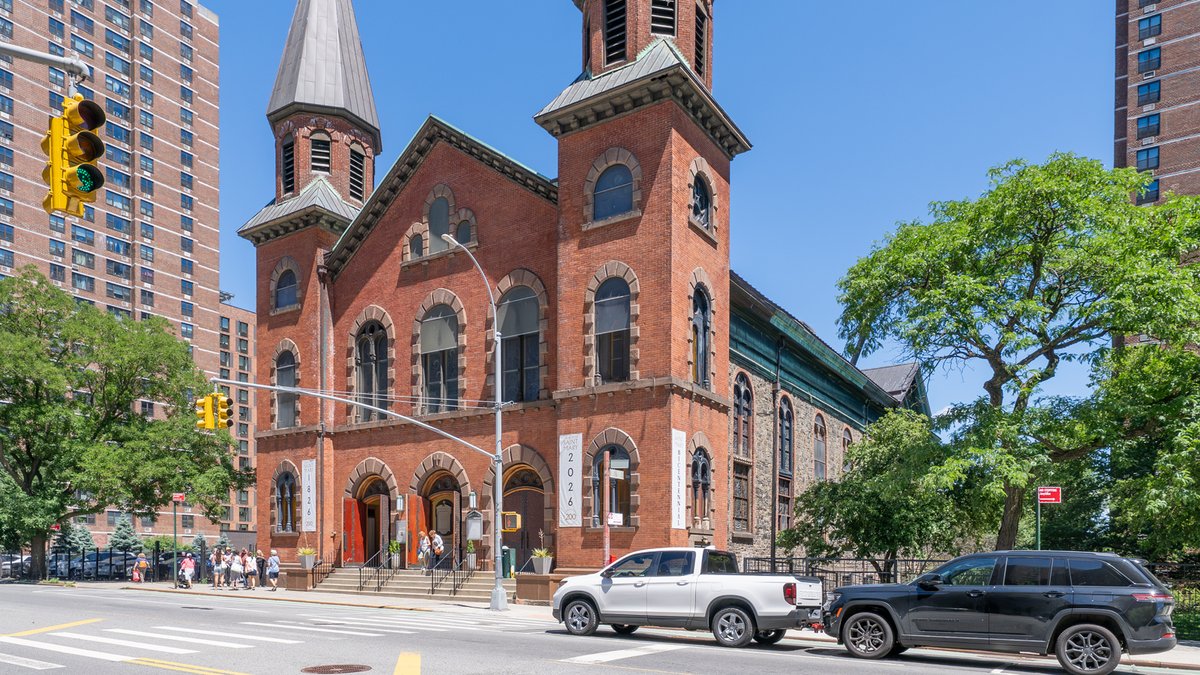
Tuesday, this past week, the New York City Landmarks Preservation Commission held a public hearing to consider landmark designation for the Church of St. Mary’s on Grand Street. (I learned of this through LESPI, the Lower East Side Preservation Initiative.)
The purpose of the hearing? To collect testimony from community members and organizations tied to the church, and notably those who would like to see it landmarked.
In New York City, when a building is landmarked, it means that the New York City Landmarks Preservation Commission (LPC) deems it historically, architecturally, or culturally significant, and it is, therefore, protected under the city’s Landmarks Law. When a building is landmarked in New York City, it doesn’t mean “hands off” forever, but it does introduce a touchy wrinkle: Owners must submit their plans to the Landmarks Preservation Commission for review and obtain approval — a Certificate of Appropriateness, a Permit for Minor Work, or a Certificate of No Effect — before the Department of Buildings will issue the permits needed for construction to proceed.
The Church of St. Mary’s dates back to 1833 and is distinguished as one of the oldest in the city, apart from St. Patrick’s on Mott Street. The original parish was founded in 1826 to serve Irish Catholic immigrants, many of whom settled on the Lower East Side to be near shipbuilding and maritime-related jobs along the East River waterfront.
After a (suspicious) fire destroyed the initial church on Sheriff Street, the congregation purchased land on Grand Street and constructed a new church built with fieldstone walls and designed in the Greek Revival style. Three decades later, Irish-born architect Patrick C. Kelly redesigned the façade, which is still mostly intact today.
From its origins, St. Mary’s congregants were mainly Irish Catholics who had settled in the neighborhood during the early nineteenth century. Over time, the surrounding population had roots in Western Europe, then Eastern Europe, and then — by the mid-twentieth century — Puerto Rico and the Latin American diaspora.
Despite the changing face of the neighborhood, the structure itself has remained largely unchanged. During the 1960s, the church partnered with the federal Department of Housing and Urban Development to build affordable housing in the area. This led to the creation of the Grand Street Guild, the organization behind the construction of the 26-story towers at 410 Grand Street, 460 Grand Street, and 131 Broome Street.
A promising sign, noted in The Lo-Down’s January coverage, is that the Roman Catholic Archdiocese of New York has not opposed landmark designation — an important signal from the church’s owner, since such support would be unlikely if there were plans to close or sell the property. The same article also notes that the rectory at 28 Attorney Street is not included in the Landmark Preservation Commission’s designation brief.
For me, this could be the most interesting part of the story.
If the church itself is landmarked, it would largely preserve the building in its current form; however, because the rectory is not included in the designation, that parcel — along with its adjacent parking lot — could potentially be redeveloped in the future. (If you recall our article on 222 East Broadway article, the Bialystoker Home for the Aged is also a landmarked property, yet a modern residential tower was later built above and alongside it.) By leaving the rectory unprotected, the possibility remains that the remainder of the property could be adapted to other uses over time.
This year, St. Mary’s celebrates its bicentennial. Supporters and believers alike can begin the celebrations early as news has come through from the Landmarks Preservation Commission that St. Mary’s will be landmarked.
What are your thoughts? Should the church be landmarked?
Sources
Lower East Side Preservation Initiative (Statement of Significance)
Lower East Side Preservation Initiative (Cover Letter)
The Lo-Down (St. Mary’s Campaign)


