

A Tribute to Czech and Slovak Heritage on the LES
Masaryk Towers
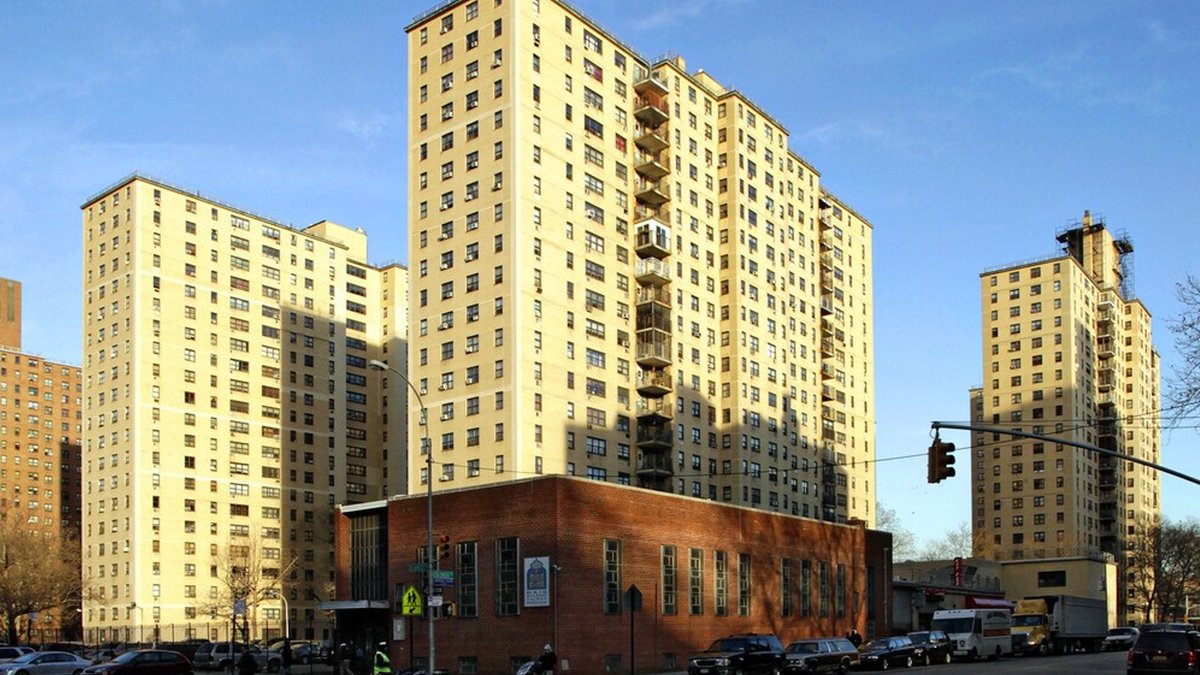
If you’re bold enough to walk north, under the Williamsburg Bridge on Columbia Street, dodging the perching pigeons and their droppings, you’ll land at the foot of Masaryk Towers.
The six-brick-tower complex sits above the East River waterfront, monitoring progress on the East Side Coastal Resiliency Project while stating its six-decade claim to the land. Masaryk occupies the superblock bounded by Delancey Street, Columbia Street, and East Houston Street, and is home to more than 1,100 apartments and thousands of residents.
As a postwar urban renewal project, it remains one of New York City’s largest remaining Mitchell-Lama cooperatives. Constructed in the mid-1960s under New York’s Mitchell-Lama housing program, it was intended to provide affordable homeownership opportunities for middle-income New Yorkers—families who earned too much to qualify for public housing but could not afford Manhattan’s private market.
The development takes its name from Jan Masaryk, the Czech foreign minister and son of Tomáš Garrigue Masaryk, the first president of Czechoslovakia. (I, too, wondered: Was Masaryk a community organizer, charitable priest, or benevolent shopkeeper from the Columbia Street of yesterday? No, is the answer.)
Masaryk was a leading Czechoslovak statesman whose mysterious death in 1948, following the Communist takeover of Czechoslovakia, remains one of the enduring mysteries of the early Cold War. (He fell, jumped, or was pushed from a window.) In recognition of the Lower East Side’s historic Czech and Slovak community, the cooperative was named in his honor posthumously.
Before the 1950s, much of the Lower East Side consisted of aging tenements. Rather than rehabilitate individual buildings, urban planners assembled large superblocks, removed portions of the traditional street grid, and replaced them with high-rise apartment towers surrounded by landscaped open space. The Masaryk project represented the philosophy of the era: more sunlight, more open space, modern construction, and the separation of pedestrians from automobile traffic.
Unlike nearby NYCHA developments, however, Masaryk was never intended as public housing. Residents purchased shares in a limited-equity cooperative, allowing them to build modest equity while preserving long-term affordability through restrictions on resale prices and income eligibility.
For reference, a limited-equity cooperative is a housing model where apartment resale prices are capped by formula to keep homeownership permanently affordable for low- to middle-income families. This means that if a shareholder decides to move and sell their unit, they cannot list it at the open market price—even if neighboring Manhattan apartments sell for $1 million. Instead, they must resell their shares at a pre-set, capped price (often calculated from the initial purchase price plus fixed appreciation and approved improvements) so the next potential shareholder can afford to buy in.
Affordability remains central to the cooperative’s mission today. Masaryk has chosen to remain within the Mitchell-Lama program, while many similar developments have privatized over the past several decades. In June 2025, the cooperative closed on a $32.68 million financing package through the New York City Housing Development Corporation to rehabilitate its six residential buildings.
That investment followed years of capital improvements, including resiliency work undertaken after Superstorm Sandy exposed vulnerabilities throughout the East Side. Like many waterfront (and water-adjacent) developments, Masaryk has invested heavily in protecting its infrastructure against future flooding while modernizing aging building systems.
It has also taken measures to ensure public safety by limiting access to the general public. In 2017, Masaryk Towers decided to close the pedestrian gates through the complex—a debate that has been rather heated at times. According to then-City Council Member Rosie Mendez, the closure stemmed in part from concerns over liability and insurance costs that arose during an earlier HPD-funded renovation. The cooperative made a compromise, though, agreeing to keep the gates open during peak hours to preserve an important pedestrian route between Columbia and Pitt Streets—particularly for seniors and families accessing Grand Street Settlement.
While the physical history of Masaryk Towers has been documented in public records, another question is harder to answer: What is daily life inside the complex actually like?
To get an idea, we reviewed and analyzed every 311 service request associated with the property between 2020 and the present. The analysis identified 1,053 reports originating from the complex, representing nearly half of all 311 complaints recorded along Columbia Street during the period.
Noise overwhelmingly dominates the complaint history. Residential noise alone accounts for 464 complaints, or 44% of all reports. When combined with street, vehicle, commercial, and other noise complaints, more than 55% of all 311 activity involves quality-of-life issues rather than building maintenance. Elevator complaints account for 4%; heat and hot water complaints represent 2%, while unsanitary conditions account for 4% of complaints.
The data support several observations while also illustrating the limits of what 311 records can tell us.
First, Masaryk’s complaint profile is driven primarily by neighbor and neighborhood issues rather than by reports of chronic building system failures. Second, the relatively modest number of complaints involving heat, hot water, and elevators does not suggest widespread recurring failures in those systems. At the same time, 311 data alone cannot establish overall building quality, as many maintenance issues are resolved directly through management without ever becoming city complaints.
Like any large residential community housing thousands of people, Masaryk Towers inevitably generates a significant volume of service requests. The more meaningful question is not simply how many complaints exist, but what they concern. In the case of Masaryk, the answer appears to be that the overwhelming majority involve the challenges of urban living: neighbors, noise, and quality-of-life concerns.
Nearly sixty years after welcoming its first residents, Masaryk Towers continues to represent one of New York City’s most significant affordable housing success stories. It has weathered changing demographics, evolving neighborhood dynamics, financial pressures, major capital improvements, and the continuing challenge of preserving affordability in Manhattan, while also offering some of the best proximity to East River Park’s brand-new tennis courts.
Sources
- New York City Housing Development Corporation
- New York City Department of Housing Preservation and Development
- New York State Homes and Community Renewal
- NYC Open Data
- NYC ACRIS
- NYC Department of Buildings
- Masaryk Towers Gate Coverage
- Czech Diplomat Jan Masaryk Dies Under Strange Circumstances
- There’s No Place Like Home: Lower East Side’s Masaryk Towers (Laurie Markiewicz)